
Chinese President Xi Jinping is set to visit the United States from September 23 to 25 for summit talks with US President Donald Trump, with discussions expected to cover critical economic and trade issues, including AI, and the recently signed US sanctions law targeting countries buying Russian oil and gas.
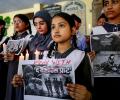
An Indian delegation met top officials of the United Nations Office of Counter-Terrorism (UNOCT) and Counter-Terrorism Committee Executive Directorate here even as New Delhi stepped up efforts to designate The Resistance Front, a Lashkar-e-Tayyaba proxy, as a UN-listed terror outfit for its alleged involvement in the Pahalgam attack.

The US-China rapprochement, however tenuous, is not without implications for India. Both China and Pakistan have become closer to the US, notes Ambassador T P Sreenivasan.

Spokesperson in the Ministry of External Affairs Anurag Srivastava said India expects China to refrain from commenting on the country's internal affairs and respect its sovereignty and territorial integrity.
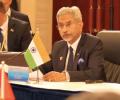
Jaishankar said the UN Security Council condemned the attack and underlined the need to hold perpetrators, organisers, financiers and sponsors of the reprehensible act and bring them to justice.

Russian Foreign Minister Sergey Lavrov said Moscow sees the prospect of making the Security Council more democratic, exclusively, through broadening the representation of countries from Africa, Asia and Latin America.

In his address at the elite Peking University, he referred to the establishment of the diplomatic relations between India and China in 1950 and the bilateral relations that have been tested by difficulties and challenges in the last seven decades.
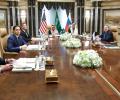
The US move to align with Russia is prompted by fear of a Sino-Russian joint threat. Russia, fully aware of its military vulnerability vis a vis China may cautiously welcome the American move, assesses Colonel Anil A Athale (retd).

China appears determined to upgrade Pakistan's military capabilities, sufficient to ensure local parity with India, alerts former foreign secretary Ambassador Shyam Saran.

Times have changed, situations have changed, but the basic nature of superpower geo-politics remains the same and so also India's diplomacy -- call it non-alignment, strategic autonomy or neutrality; it all depends on the time scale, notes Rup Narayan Das.

The BRICS nations condemned the Pahalgam terror attack, advocated for a zero-tolerance approach to terrorism, and criticized rising tariffs during their summit in Rio de Janeiro. They also addressed global challenges and called for reforms in international institutions.
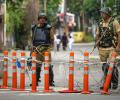
'India needs to closely monitor the discussions at the UNSC and make counter-measures as this touches its core interests', points out Srikanth Kondapalli.
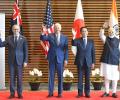
Chinese and Russian warplanes on Tuesday conducted joint air patrols over the Sea of Japan, the East China Sea and the West Pacific Ocean as the leaders of Quad held their in-person summit in Tokyo, in an apparent attempt to send a message of unity between Beijing and Moscow.

The Security Council as it is today is unable to bring peace and security in the world and so there is reason for countries like India to become members of the Council, Ambassador Asoke Kumar Mukerji tells Sheela Bhatt/Rediff.com.
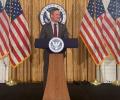
Waltz after being elected as the Co-Chair of India Caucus in January last year had said that India is the world's largest democracy and an important strategic partner for the United States.

UN Secretary General Ban Ki-moon denounced the launch and asked North Korea to halt its 'provocative actions' and return to compliance with its international obligations.

Russian President Vladimir Putin on Wednesday warned America and its allies against one-sided intervention in Syria, even as US said it not only risks losing friends but also credibility at the world stage if no military action is taken against the Bashar al-Assad regime.

Taking to Twitter, United Nations Human Right Council said, 'At its 35th special session, the @UN Human Rights Council decided to create a new fact-finding mission to investigate alleged #HumanRightsViolations in the Islamic Republic of #Iran related to the protests that began on 16 September 2022.'

Iran was ousted from the United Nations Commission on the Status of Women on Wednesday evening in the wake of the Mahsa Amini protest.

A genuine attempt was made to reset relations in a positive way, signalling a stepping back from the brink of conflict, much to the relief of the world, observes Ambassador T P Sreenivasan.
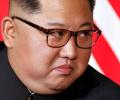
The visit, Kim's third since March, is taking place amid sharp escalation rhetoric between Beijing and Washington over tariffs almost spiralling into a trade war.

The scaling up of the India-US strategic partnership to the level of non-NATO ally with defence deals, sharing and transfer of defence technology, interoperability, joint collaboration and joint production of defence equipment has exacerbated Moscow's anxiety, notes Rup Narayan Das.

Describing Central Asia as India's "extended neighbourhood", Doval said New Delhi accords "highest priority" to this region, adding Afghanistan is an important issue "concerning all of us".

The United States, the United Kingdom, the European Union and NATO have expressed concern on the new law and warned of retaliatory measures.
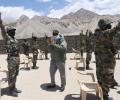
Only he, with his tremendous political capital and personal stature, can pull it off, observes B S Raghavan, the veteran civil servant.
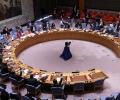
India has abstained on yet another resolution involving Ukraine, this time a motion sponsored by Russia at the United Nations Security Council (UNSC) that sought to establish a commission to investigate claims by Moscow that the United States and Ukraine are carrying out 'military biological activities' in laboratories in Ukraine in violation of the biological weapons convention.

Prime Minister Narendra Modi and Chinese President Xi Jinping on Thursday began summit-level talks.

The best, wisest, and fairest next step in strengthening our own cause is to restore statehood to Jammu & Kashmir and allow the resumption of robust political activity. That's a box that remains unchecked on the Modi government's report card as we approach the fourth anniversary of Kashmir's Constitutional shift, notes Shekhar Gupta.

Talking about the threat of terrorism, he said "As diverse and pluralistic societies, we both face threats from fundamentalist terrorism. Yet, we do not seem to be able to cooperate as effectively we should in some critical international forums dealing with this subject."

The report documents allegations of reprisals and intimidation in 38 countries, some of which are members of the Human Rights Council.

Trump's tweet comes after Kim Jong-un blasted the US President Donald Trump as "mentally deranged" and vowed to make him pay dearly for threatening to destroy his country.

'His secularism merely declared the equality of all religions in India under fundamental rights.'

For India to view the new Sri Lankan leadership only through the prism of the past or through their narrow view on China, is fraught with possibilities that should be avoided, asserts N Sathiya Moorthy.
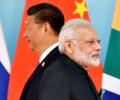
'The events of 2020 have actually put our relationship under exceptional stress.' What External Affairs Minister Dr Subrahmanyam Jaishankar told the All India Conference of China Studies on Thursday, January 28, 2021.

Backing New Delhi's quest for a permanent seat in the UNSC, Rouhani asked why India, a nation with population of 1.3 billion, was not a member of the powerful club.

Russia and China have a broad consensus today on almost all core issues related to global strategic stability, which is unprecedented in modern history, observes Ambassador M K Bhadrakumar.

Top security czars of India, Russia, Iran and five central Asian countries on Wednesday pledged to work for ensuring that Afghanistan does not become a safe haven for global terrorism and called for the formation of an open and truly inclusive government in Kabul.

However, Kim gave no indication of Pyongyang willing to give up its nuclear weapons
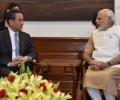
Wang and Swaraj also discussed issues relating to annual BRICS summit which will be hosted by India in Goa in October.
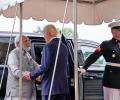
Foreign policy is always a work in progress and ups and downs are built into foreign policy process. What is permanent is national interest. Hopefully, this year, which will also witness general elections in the country, will also clear clouds in the foreign policy horizon, observes Rup Narayan Das.
